Fitting to Data
The code can fit the signal model to the data of timing residuals by setting FlagRec to 1 in parameter file (see Parameter File).
The major output data files are posterior_sample_pt.txt, ptr_rec.txt and pptr.txt in the subdirectory data/.
posterior_sample_pt.txtis the posterior sample of all model parameters, and i-th column corresponds to the i-th parameter in the model.ptr_rec.txtis reconstructed timing residuals by model parameters given inposterior_sample_pt.txt. It has \(N_{\rm t}\) columns and \(N_{\rm ps} N_{\rm p}\) rows, where \(N_{\rm t}\) is the the number of data points in timing residuals of each pulsar, \(N_{\rm p}\) is the number of pulsars and \(N_{\rm ps}\) is the size of the sample. Row \(1\) to row \(N_{\rm p}\) is the reconstructed timing residuals using the first set of parameters in the sample, and so on. The observation times of timing residuals is the same as that of the input data and so neglected here.pptr.txtis predicted timing residuals using the mean of each parameter of the sample.
Run
python plot_rec.py
in the analysis subdirectory will output figures residual.pdf, skymap.pdf and corner_i.pdf.
residual.pdfis the plot of reconstructed pulsar timing residuals of each pulsar.skymap.pdfis the posterior distribution of sources’ locations on the celestial sphere.corner_i.pdfis the probability distributions of model parameters of the i-th source.
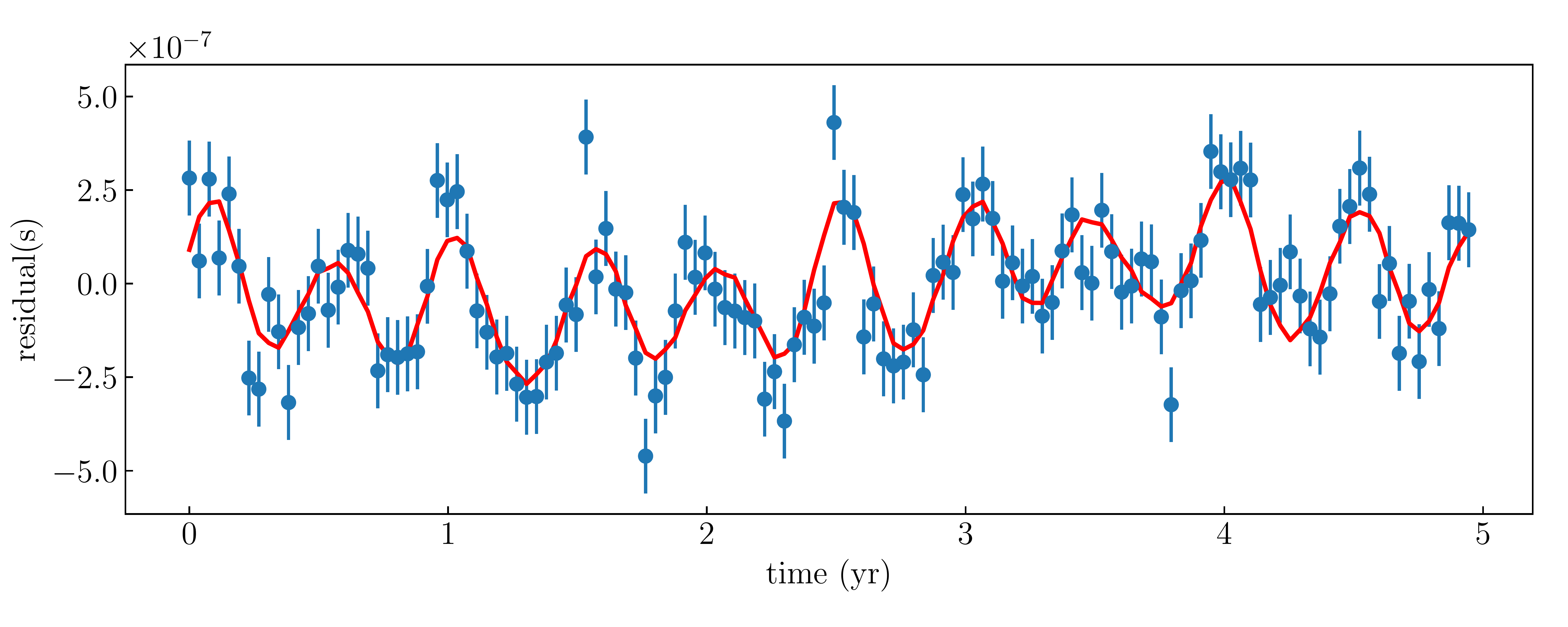
Example for reconstructed timing residuals of a pulsar. The red line is the reconstructed timing residuals with smallest chi-square.
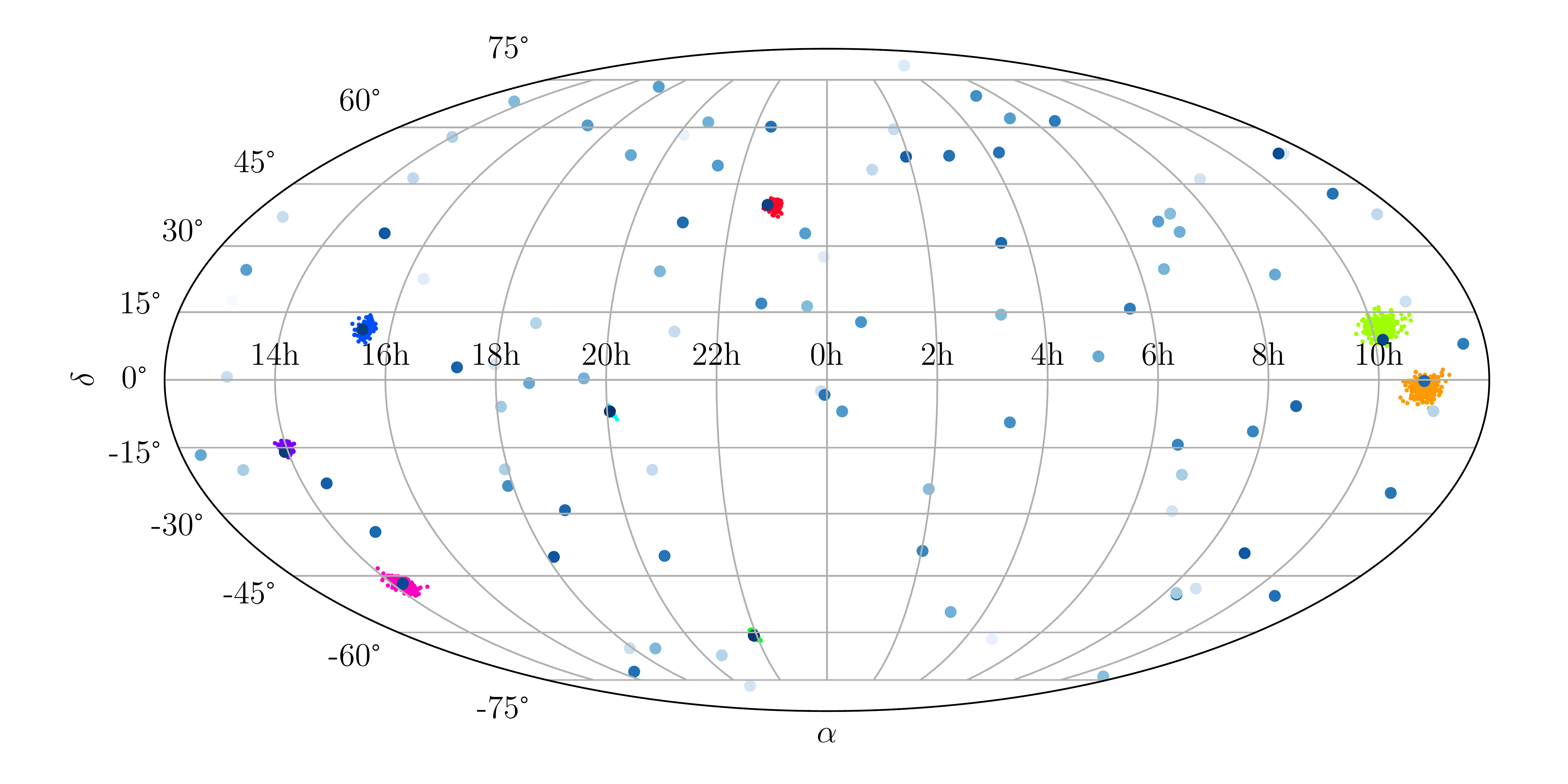
Example for the posterior distribution of eight sources’ locations on the celestial sphere.

Example for the probability distributions of model parameters of the source with lowest orbital angular frequency.